
Reading Diary
Eclectic dispatches from the bedside table

(A quick aside before we begin: It’s been a few years since I’ve offered summer editing specials, opting instead to wait for the end of the year. But I have a single slot that’s come open, so if you’ve had any thought of working with me on your writing project, either a full manuscript edit or hourly support, please drop me a line - the savings over my rack rate are substantial, as much as 40%. First come, first served.)
My reading has been a bit haphazard of late, which can happen when I’m writing something new; but things are settling into what seems a reasonable summer pace and I thought I’d share a few impressions for those who might be interested. It’s interesting to see how the reading has clustered around a few themes.
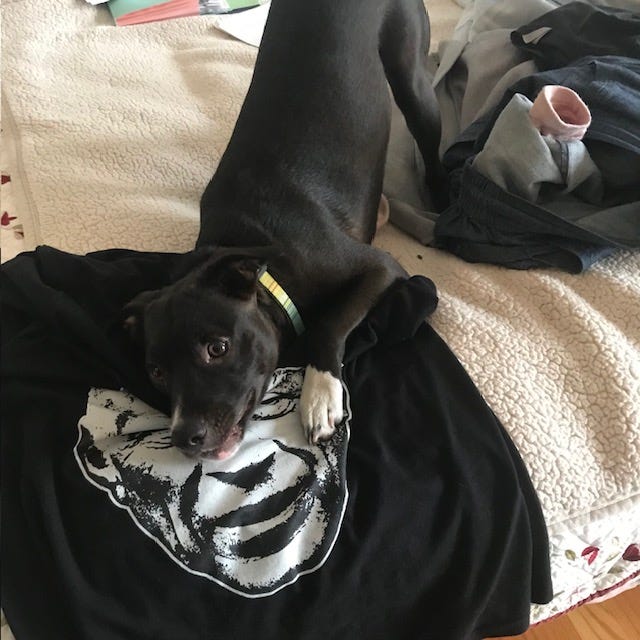
I have had what I confess is a slightly weird and unexpected turn regarding my lifelong habits of eating animals. I don’t yet know where it will all land for me and I want to be very clear - I am not proselytizing, preaching, or holding myself up as any kind of paragon. In truth, I’m a bit ashamed of the banality of my so-called revelations, which stem from my beloved canine Berger (named for John); perceiving his intelligence and emotion on a daily basis caused something to shift in me about my relative indifference to animal suffering, especially in the name of corporate farming. That not eating meat might help climate change and prolong my life have been, to repeat the word, weirdly secondary in my current state of thinking.
There were a number of books that rather fortuitously lined up to influence my thinking, beginning with Sigrid Nunez’s terrific What Are You Going Through, her (in my opinion, superior) follow up to The Friend. This new novel is a moving consideration of aging and end of life; but it opens with a male writer friend of the narrator giving a talk about, basically the end of the world. He believes we are too far gone, climate is doomed, and the only responsible thing is to not have children. (His talk is not well-received.)
I thought of this character as I read Adam Kirsch’s new survey of transhumanist pessimism, The Revolt Against Humanity. This monograph looks at an eclectic group of thinkers who essentially believe that the world would be better off if the human race ceased to exist. All I can say is, despite the fringe-y nature of his subjects, there were times I was hard-pressed to disagree. (Mark O’Connell’s superb NYRB review - nearly as long as this short book - is worth your while to get the gist.)
Around this time I returned to J.M. Coetzee’s Lives of Animals, a short work that was later rolled into Elizabeth Costello, in which Costello gives a talk likening our present treatment of animals to the Nazis. (I should add that I am in a minority on the topic of Elizabeth Costello, a novel I have always loved in all its unvarnished crankiness.) I paired this with Peter Singer’s updated version of Animal Liberation and I found his ethical and philosophical arguments terribly persuasive, hard to rebut. I also did take a run at Jonathan Safran Foer’s Eating Animals, though I found it too, well, Foer, to stick with.
Finally, in Berger’s honor, I returned to his namesake’s wonderful essay Why Look At Animals.
A second reading cluster emerged around a well-documented passion of mine: The Beatles. If ever a non-fiction book was pitched right into my strike zone, it would surely be Love and Let Die: James Bond, The Beatles, and the British Psyche (007 being my other enduring pop culture obsession.) The book jumps around through a collection of brief essays, connecting this bit of Beatles lore with that bit of Bond trivia. Some of the connections - Love Me Do (the first Beatles single) and Doctor No (the first Bond movie) were both released on October 5, 1962 - can feel downright freaky, whereas others felt strained. And over the length of this quite 400 pages, I began to wonder who the book was actually for; the trivia is too familiar for aficionados and too obscure for general interest readers.
I also picked up a pair of McCartney specific titles: 1964 Eyes of the Storm, his book of photos he took on his first American tour with the Beatles; and The McCartney Legacy, Volume 1: 1969-1973 by Allan Koznin and Adrian Sinclair. The photos are just terrific, a handsome coffee table publication that gives you a rare inside-the-bubble view of the madness that gripped the world as Beatlemania really took hold. Sure, Paul is no Ansel Adams (that would be unfair - how much talent can one person be allowed?); but there is an undeniable energy in these photographs that feels vital, unmediated.
The biography continues the current trend of Beatles Maximalism, 700 pages to cover four years, though the first two of those years involve the splintering of The Beatles. (We have Beatle historian Mark Lewisohn to thank/blame for this trend: His first volume of his definitive biography of the Fab Four comes in at 944 pages and ends with Love Me Do. Two more volumes are promised.) I was skeptical when confronted with the sheer girth of the McCartney project though I am a Paul partisan. (He has always, to my ear, been the musical heart of the Beatles. Without him, John could have easily ended up running a mildly successful used record store in Speke.) I am mid-way but pleasantly surprised; it is highly readable, detailed but not as oppressive as Lewisohn, and is full of new details, particularly around those early post-Beatles recordings. The authors do an especially good job with Paul’s depression following the Beatles’ split and the legal battles required to extricate him from Apple. The book is fair, Paul is seen warts and all. This is no hagiography; it feels like a splendid addition to the shelves of Beatles scholarship. Though what is up with the janky Photoshop cover is beyond me …
(One more nugget for my Beatles fan friends: I am not a podcast listener; I find most of them unbearably tedious, hyperactive, performative, masturbatory bro-chat. But Jason Kruppa’s Producing the Beatles is a marvel; scripted, thoughtful, a deep technical consideration of their development as recording artists under George Martin’s watchful eye. I only wish there were more episodes; if all podcasts were like this one, I’d listen. His latest, to bring things full circle, looks at Paul’s classic 007 title track for Live and Let Die.)
And one more nugget for the Bond fans among you: Percival Everett’s Dr. No is hilarious, brilliant, a complete intellectual thrill ride, a witty homage to the world of Bond super villains.
Another cluster of books has formed around the research for my current novel, a comedy narrated by a has-been drummer. This has spun me off into the world of music memoirs and related works. A few that have made a real impact on me include Let’s Go (So We Can Get Back), Jeff Tweedy’s memoir, which I found nicely self-deprecating and informative; Ripped: How the Wired Generation Revolutionized Music and David Byrne’s classic How Music Works have both been spectacularly informative; and finally, Carlo Rovelli’s The Order of Time has been a wonderful introduction for me to the work of this popular Italian physicist.
I did read Shy, the new Max Porter, which I wanted to like more than I did but I felt, for the first time, a kind of sameness settling over his work. (Though folks I respect do seem to love it.) And I re-read C.P Taylor’s play Good in preparation to see the National Theatre Live production with David Tennant. As readers of this newsletter know, I was not a fan of Leopoldstadt, though I love Stoppard too much to begrudge him his Tony; sort of like McEwan’s Booker for Amsterdam. But if you want to read/see a play that deals with the rise of Nazism in original and shocking ways, go see Good, which I think is vastly superior.
My current read is Anuk Arudpragasam's The Story of a Brief Marriage, which contains one of the most harrowing opening scenes I can remember reading in a very long time. I’ll report back in Part Two of this missive but so far, I am engrossed.
What have you been reading? What should I be looking at? The summer stretches out ahead, and operators are standing by.
Lovely to read about your vegetarian evolution and its thoughtful origins. Bravo.
I’m guessing you’ve sampled Rick Rubin’s Broken Record podcast? (episodes with Ringo Starr and Giles Martin) Such fun research you’re doing. Your drummer novel will be a delight – looking forward to it.
Thank you for giving up meat for all the worthy reasons you list. And thank you for listing so many other inspiring titles. I look forward to your next missive!